December 09, 2025
Best Corporate Cards for Startups: No Personal Guarantee Options for 2026

Sign up for our newsletter
Stay informed with the latest trends and best practices in finance and procurement.

You've just raised a Series A. Your company has $3M in the bank and 25 employees. You're growing fast, subscriptions are piling up, and you need corporate cards for your team.
Then the card provider asks you to personally guarantee the debt. Wait, why would your house be on the line for business expenses when your company is funded?
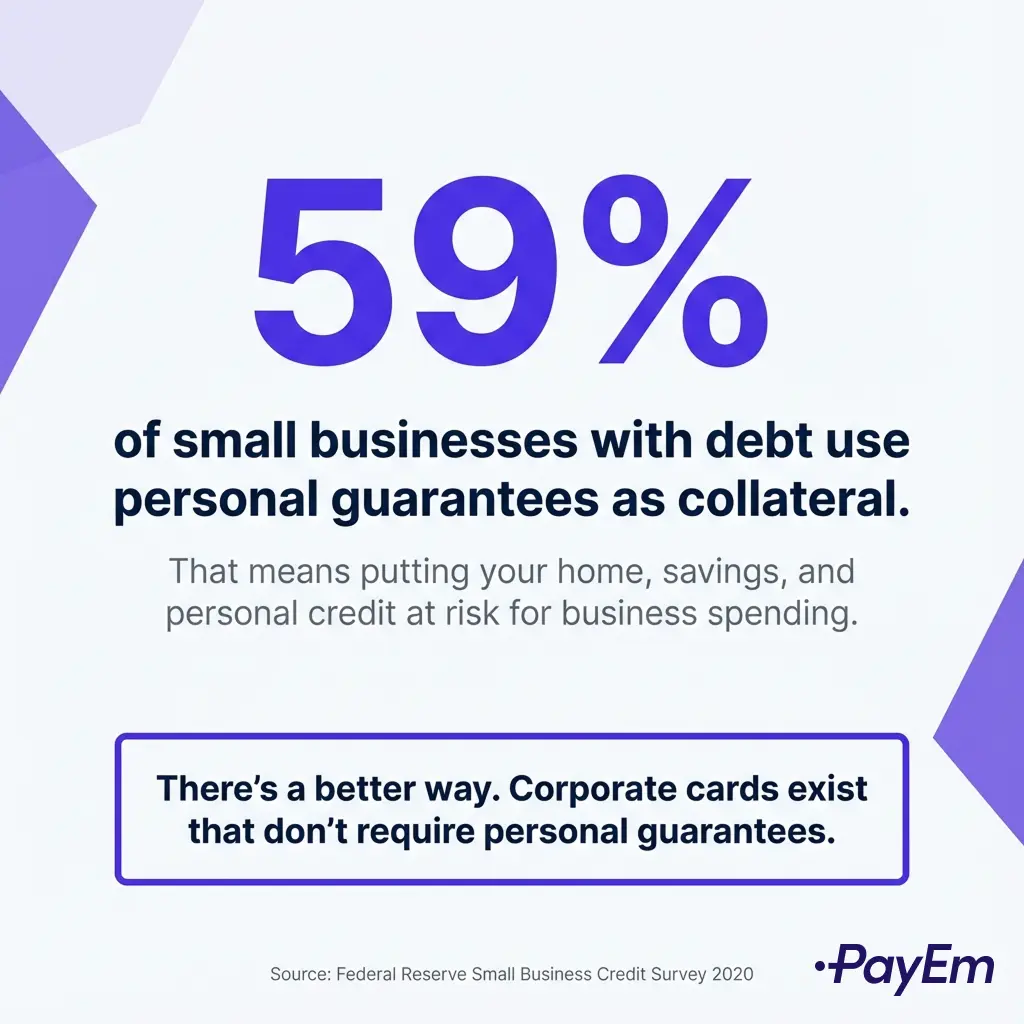
If this sounds familiar, you're not alone. According to the Federal Reserve's Small Business Credit Survey, 59% of small firms with debt use personal guarantees as collateral. That means more than half of business owners have put their personal assets - homes, savings, credit scores - at risk for company spending.
Here's what most founders don't realize: personal guarantees aren't always necessary. Several corporate card providers now underwrite based on your business metrics alone - no personal credit checks, no home equity risk, no personal liability if things don't work out.
This guide shows you exactly which cards don't require personal guarantees, what you need to qualify, and how to protect your personal finances while scaling your startup.
What Is a Personal Guarantee? (And Why It Matters More Than You Think)
A personal guarantee is a legal promise that makes you personally responsible for your company's debts. If your business can't pay back what it owes, the card provider can come after your personal assets.
What's actually at risk:
- Your personal credit score
- Your home (if you've used it as collateral)
- Personal savings and checking accounts
- Other personal assets like vehicles or investments
When it triggers:
- Your company runs low on cash
- The business pivots or closes
- You miss payments during a rough quarter
- The company files for bankruptcy
The tricky part? Personal guarantee clauses are often buried in the fine print. Terms like "continuing guarantee" or "limited guarantee" sound less scary, but they mean the same thing: you're on the hook.
The Hidden Cost: A Founder's Story
Sarah (not her real name) founded a B2B SaaS company and raised a seed round. She signed up for a well-advertised corporate card without fully reading the terms. The card had a $100K limit, which seemed perfect for her growing team.
Eighteen months later, the company needed to pivot. Revenue dropped, and they decided to wind down responsibly. But there was $80K in outstanding card charges from that final quarter, software subscriptions, contractor payments, AWS bills.
Because of the personal guarantee clause buried on page 7, paragraph 3 of the agreement, Sarah was personally liable for that $80K. It took her three years to pay it off using personal funds, and it dinged her credit score significantly.
The lesson: That checkbox you clicked? It might have just pledged your personal assets without you fully realizing it.
Corporate Cards Without Personal Guarantees: Your Options
Good news: several providers now underwrite based on business health rather than founder credit. Here's how they compare:
Comparison Table
Note: Requirements updated as of December 2025. Always confirm guarantee terms in writing before signing.
How Providers Underwrite Without Personal Guarantees
Different providers use different criteria. Understanding these helps you pick the right fit for your stage:
1. Cash Balance Underwriting
How it works: Your credit limit is a percentage of your bank balance, usually 10-30%. If you have $1M in the bank, you might qualify for $100K-$300K in credit.
Pros:
- Fast approval (often 24-48 hours)
- No personal risk
- Scales with your funding
Cons:
- Requires significant cash reserves
- Limits tied to runway (can decrease if balance drops)
Best for: Funded startups with 6+ months of runway
Example: A Series A company with $2M in the bank might get approved for a $400K credit line without any personal guarantee.
2. Revenue-Based Underwriting
How it works: Credit limit is tied to your monthly recurring revenue (MRR) or annual revenue. Providers typically offer 30-50% of your MRR as a credit limit.
Pros:
- Works for profitable bootstrapped companies
- No need for venture funding
- Grows as your revenue grows
Cons:
- Need consistent revenue history (usually 3-6 months)
- Lower limits for early-stage companies
Best for: Bootstrapped SaaS, agencies, service businesses with predictable revenue
Example: A bootstrapped SaaS company with $50K MRR might qualify for $15K-$25K in credit limits.
3. Venture Backing Underwriting
How it works: Approval based on who your investors are and the size of your funding round. Tier 1 VCs often unlock higher limits.
Pros:
- Higher limits for early-stage companies
- Fastest path to approval for VC-backed founders
- No revenue requirements
Cons:
- Must have institutional investors (not friends/family rounds)
- Investor pedigree matters (a16z vs. angel investors affects limits)
Best for: VC-backed startups from Seed through Series C
Example: A Seed-stage company that raised $2M from a top-tier VC might get $150K-$250K limits on day one.
4. Hybrid Models
Some providers combine multiple factors such as cash balance + revenue + investor backing. These can be more flexible but also more complex.
Critical tip: Even with hybrid models, always ask explicitly: "Is there ANY scenario where I'm personally liable?"
8 Questions to Ask Before You Sign Anything
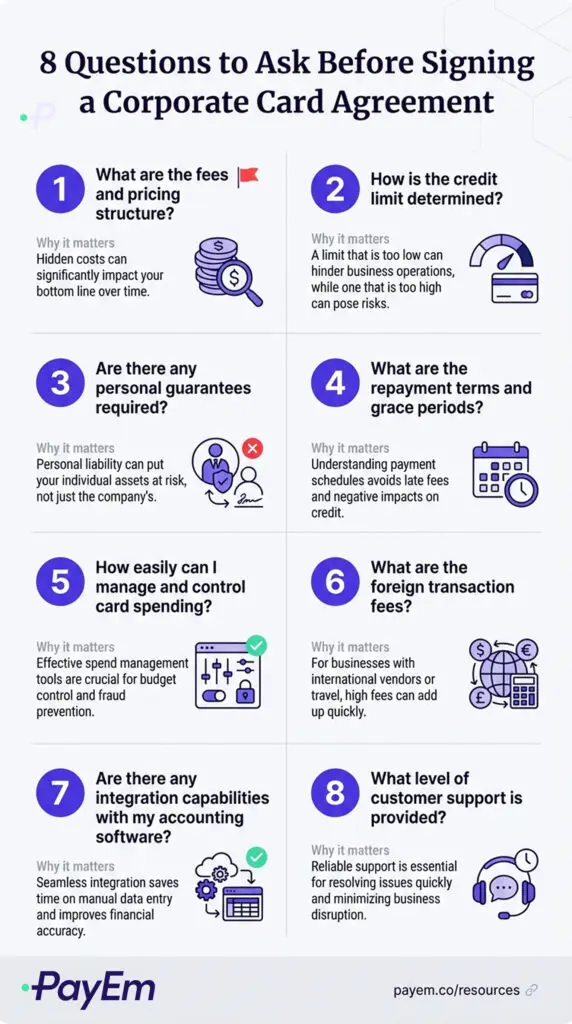
Use this checklist during sales calls. If the rep can't answer clearly, ask for written confirmation:
1. "Is there ANY scenario where I'm personally liable for company charges?"
Follow-up: "What happens if the company runs out of money? Am I still liable?"
2. "Do you pull personal credit reports on founders?"
Red flag: If yes, they're likely building a case for personal guarantee.
3. "What happens if the company closes or pivots?"
Get specific: Who's responsible for outstanding balances?
4. "What's your exact underwriting criteria?"
They should give specifics: "We require 6 months of cash runway" or "Your credit limit is 20% of your bank balance."
5. "What are typical credit limits by funding stage?"
Helps you set realistic expectations and compare offers.
6. "Can you provide the full terms in writing BEFORE I submit my bank information?"
Never share banking credentials until you've reviewed complete terms.
7. "Do you report to personal or business credit bureaus?"
Personal reporting = personal credit exposure, even if they claim "no personal guarantee."
8. "What's required for credit limit increases down the line?"
Make sure future increases don't trigger new guarantee requirements.
💡 Pro Tip: Get a Lawyer to Review the Terms
Cost: $300-$500 for legal review
Potential savings: Your house
Personal guarantee clauses hide in:
- Sections titled "Cardholder Agreement"
- Terms of Service (not the marketing one-pager you saw)
- "Continuing Guarantee" addendums
It's worth having a lawyer review before you sign. Think of it as insurance for your personal assets.
When Personal Guarantees Might Actually Make Sense
Let's be balanced: personal guarantees aren't always terrible. They might make sense if:
✅ You're pre-revenue and need cards immediately
✅ Your business has minimal cash reserves
✅ You plan to pay off balances weekly (not carry debt)
✅ You're bootstrapping and can't meet VC-backed or revenue requirements
If You Must Accept a Personal Guarantee, Mitigate Your Risk:
- Set internal card limits well below the contract limit (if they give you $50K, cap individual cards at $5K)
- Use separate cards for recurring vs. one-time expenses (easier to track and control)
- Set up auto-pay from your business checking account (never miss a payment)
- Review liability monthly (know exactly what you're on the hook for)
- Consider business credit insurance (exists for certain industries - ask your insurance broker)
Alternative approach: Some spend management platforms like PayEm issue virtual cards backed by your existing business checking account. You're not taking on a credit line at all, which means zero personal risk - no guarantee needed because there's no debt.
How to Transition Away from a Personal Guarantee Card
Already stuck with a personal guarantee? Here's how to get out:
Step 1: Qualify for a No-Guarantee Alternative
- Build runway: Get to 3-6 months of cash in the bank
- Tap your network: Ask your investors for intros to VC-backed card providers
- Join founder communities: Many have partner discounts or referral programs
Step 2: Get Approved (Don't Cancel Your Old Card Yet!)
- Provide bank statements showing stable cash balance
- Highlight growth metrics: revenue, funding rounds, customer count
- Don't mention you're trying to leave another provider, just focus on your needs
Step 3: Migrate Spending Gradually
- Start with recurring subscriptions (SaaS tools, software licenses)
- Update vendor payment methods one by one (create a spreadsheet to track)
- Keep the old card active for 30 days to catch any missed subscriptions
Step 4: Close the Old Account Properly
- Pay off the full balance
- Get written confirmation that the account is closed
- Request written confirmation that your personal guarantee is terminated
- Check your personal credit report 60 days later to ensure no ongoing reporting
Timeline: Plan for 2-4 weeks for a full, clean transition.
The Bottom Line: You Don't Have to Risk Your Home to Scale Your Startup
Here's what matters:
✔ Corporate cards without personal guarantees exist for most funding stages
✔ Underwriting criteria vary: cash balance, revenue, or venture backing
✔ Always ask explicitly about personal liability before signing anything
✔ Legal review is worth it ($500 now vs. $80K later)
✔ If you must accept a guarantee, set strict internal controls
Your startup's success shouldn't require risking your personal assets. The right corporate card lets you manage company spending while keeping your home, savings, and credit score protected.
The best time to negotiate terms is before you sign. Once you're locked in, switching is possible but inconvenient. Do your homework upfront, ask the tough questions, and make sure you're protecting both your business and your personal financial future.
Learn More About PayEm
PayEm provides corporate cards without personal guarantees for startups at any stage. Our platform combines spend management, virtual cards, and accounts payable automation. All without putting your personal assets at risk.